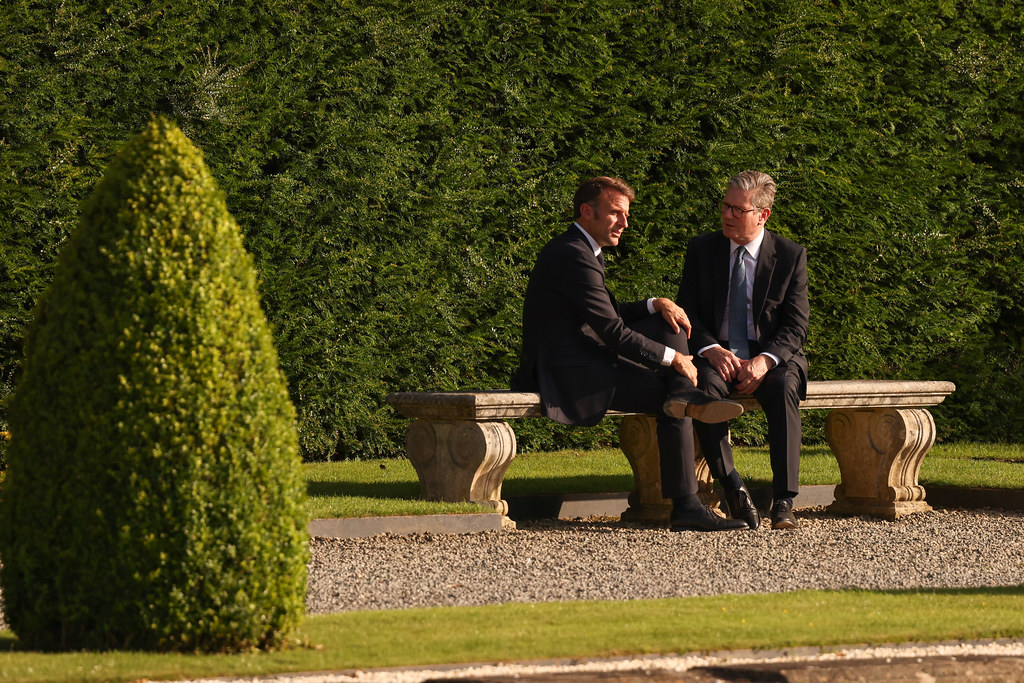
The European Political Community Summit held at Blenheim Palace on July 18 was the second opportunity for Sir Keir Starmer and Emmanuel Macron to meet in person after the NATO Summit in Washington.
The two leaders’ goals were clear: try to rebuild a closer relationship between France and the UK eight years after Brexit.
Though the ties between France and the UK were never cut since 2016 it is fair to say that they were at least loosened and sometimes tense by moments.
The Boris Johnson and the Liz Truss era didn’t do any good and Rishi Sunak, though in pretty good terms with President Macron didn’t manage to improve them that much either.
A political summit, created by Macron in 2022 to gather EU and non-EU states together was thus a good way to revive the Entente Cordiale and Starmer did pretty well. After a warm welcome of his French counterpart at the entrance of Blenheim Palace, the two leaders were seen talking together in the palace gardens.
From the right start of the summit, Starmer made quite clear that the UK wants “to work with all of you to reset relationship, rediscover our common interests.”
This message was addressed to the EU as a whole and particularly to the French. On his arrival at Blenheim, President Macron also stated quite clearly that EPC would be a “great opportunity for a reset”
In the evening, the Starmer and Macron had a dinner in Downing Street after their respective press conferences.
The goal seemed quite clear: showing the press and the world that the relationship was getting better than it had ever been in the past.
A strengthened PM, a weakened president
This fourth European Community Summit was a dreamt opportunity for Starmer to show his counterparts he had the shoulders and charisma of a world leader.
The internal and external political context were quite good for such an exercise. First, the PM got the greatest Labour majority in history at the House of Commons, despite getting only 33.8% of the vote share. This is barely higher than Jeremy Corbyn’s’ in 2020 but the number of seats is twice as big.
This comfortable majority for Sir Keir Starmer comes obviously in stark contrast with Macron’s. In early July, the French President’s party Renaissance faced a humiliating defeat at the snap-elections by falling from 245 MPs to only 168 MPs. Today, Renaissance is the third political group parliament after the far-left coalition of the Popular Front (182 MPs) and the National Rally (143 MPs).
Immigration and Ukraine
From the start of the summit, the issues of immigration and the war in Ukraine were the central topics of the discussions between Emmanuel Macron and Starmer.
Asked about his expectations on this sensitive issue, Emmanuel Macron insisted that “there is no silver bullet”.
This expression was then reused by Sir Keir Starmer at his final press conference in which he promised to tackle immigration by dealing with the gangs first, instead of enforcing the Rwanda scheme which he ditched a couple after entering Downing Street. The PM repeatedly criticised the text, calling it a “gimmick” on which the conservatives “wasted time and resources.”
Though it remains hard to know in detail what the two leaders discussed during their dinner and bilateral conversations, though a joint statement published by both Downing Street and the Élysée Palace gives a few clues. In the communique, the two leaders committed “to strengthen their cooperation on irregular migration and the fight against criminal gangs responsible for this tragic loss of life through small boat crossings. The Prime Minister presented the UK’s new Border Security Command and the vital role it will play in this mission.”
The war in Ukraine was definitely a major topic of discussion, the UK and France being the two main powers providing aid to Ukraine after the United States.
In their final joint statement, the two leaders reaffirmed their “deep commitment to Europe’s defence and security. This includes their steadfast support for Ukraine in its fight against Russia’s illegal war of aggression, for as long as it takes, and for Ukraine’s irreversible path to NATO membership.”
But the Franco-British resolve to support Ukraine shouldn’t undermine the fact that the military aid provided by the two countries combined is much smaller than that the US’. According to figures issued by the US Department of State, $53.7 billion in military assistance have been delivered to Ukraine since February 24, 2022, and approximately $54.4 billion in military assistance since Russia’s invasion of Crimea in 2014. The British have provided a total of £12.5 billion, in support to Ukraine since February 2022, of which £7.6 billion is for military assistance. Finally, according to French official sources, France has contributed so far €5.1 billion of military aid.
Added up, the two European military powers’ contribution to the Ukrainian war effort is just half as big as the American one.
And if Donald J. Trump and J.D. Vance came in power in January 2025 and decided to withdraw their support for Ukraine, Europe’s unity around Ukraine could waver seriously. European leaders in favour of a ceasefire between Ukraine and Russia, especially the Hungarian Prime Minister Viktor Orbán, could get even more vocal on the issue.
But the positive sign is certainly a common desire between the UK and France to act jointly on the main issues. This act of unity is an improvement in the bilateral relationship and could open new perspectives for the years to come.
New perspectives
The positive outcome of this summit was probably that two leaders agreed to meet again in 2025 for a new Franco-British summit. The last one took place in March 2023 at the Élysée Palace when Rishi Sunak was Prime Minister and gave rather conclusive results, especially regarding immigration and energy.
This future summit could be an opportunity to revise the bilateral agreement on immigration, already revised two years ago.
During the 2023 summit the UK government promised it would give £500 million to the French government to tackle illegal crossings. But since then, the situation in the British Channel has hardly improved at and has actually worsened.
Since January 2024, more than 15 000 have crossed the British Channel, a thousand more than in 2023. The number of crossings should still be going up in the following months and are set to hit record-high numbers by December.
Since 2007, more than £700 million have been given by the UK government to tackle illegal crossings and though some progress may have been achieved, much work is still to be done.
 From Britain to France
Leave a comment